
What can metaphors tell us about personality?
Our language is filled with metaphors (Gibbs, 1994). We have “bright” ideas, try to stay “balanced”, and feel “close” to others, but sometimes feel “down”, have “dark” thoughts, and “explode” with rage. What is the purpose of such language?
According to Lakoff and Johnson (1980; 1999), metaphors allow us to understand abstract thoughts and feelings that cannot be directly seen, heard, touched, smelled, or tasted. Stated a different way, we may speak metaphorically because we think metaphorically. Social psychologists have provided some evidence for this idea (Landau, Meier, & Keefer, 2010). For example, making people angry leads them to see the color red, consistent with metaphors for anger like “seeing red” (Fetterman, Robinson, Gordon, & Elliot, 2011). As another example, asking people to taste sweet foods renders them nicer, consistent with metaphors like “a sweet person” (Meier, Moeller, Riemer-Peltz, & Robinson, 2012). This work has provided insights into the metaphoric minds of people in general, but might metaphors also provide some insights into personality? This is an important question because personality captures the enduring, consequential ways in which people differ from each other.
Certainly, metaphors are often used to describe people’s personalities (e.g., “sweet” or “bitter”, “warm” or “cold”, “big-hearted”, etc.). But, it is also clear that we should not take such language literally. For example, it is unlikely that certain people actually taste sweet, have bigger hearts, or are warmer to the extent that they are nicer. Why do we use such metaphors to describe personality, then? According to metaphor theorists (e.g., Robinson & Fetterman, in press), metaphors aid us in conceptualizing differences between people. Consider the “sweet person” metaphor. Eating sweet foods is pleasant and rewarding just like interacting with especially nice people is pleasant and rewarding. There is thus a certain metaphoric logic to thinking of nice people as sweet. But does such logic provide any actual insights into personality?
Metaphoric preferences and biases
A useful way of proceeding is to build on metaphoric links that have been established in social psychological studies. Based on the idea that anger is metaphorically red (e.g., “red with rage”, “seeing red”), Fetterman, Meier, and Robinson (2012) hypothesized and found that anger words were categorized faster when in a red font color. Fetterman et al. (2011) similarly found that making people angry led them to more frequently “see” ambiguous patches as red in color. Additional studies have shown that people perceive opponents wearing red uniforms to be more dominant and hostile in Tae Kwon Do matches (Feltman & Elliot, 2011); and, in fact, Tae Kwon Do athletes wearing red gear are more likely to be awarded points in such matches (Hagemann, Strauss, & Leissing, 2008). That is, it appears that the color red can actually make a person more hostile (or at least dominant) in their behavior.
Fetterman and Robinson (2013) then asked people to judge the interpersonal hostility of citizens from different countries on the basis of their flags. Some flags (e.g., that of Switzerland) were primarily red, whereas others (e.g., Micronesia) were primarily blue. There was a pronounced tendency to think that people from red-flagged nations were lower in agreeableness (a personality trait related to hostility) than those from blue-flagged nations, as shown in Figure 1. There thus appears to be a systematic link of hostility with the color red. This red-hostility link may affect how we interact with others (Dovidio, Gaertner, Esses, & Brewer, 2003). For example, if hostile inferences are made on the basis of the color red, then we may be unfairly wary of, or hostile toward, citizens from red-flagged nations. Consistent with this point about unfair treatment, there is no actual link between flag color and how agreeable a country’s citizens are (Fetterman & Robinson, 2013).
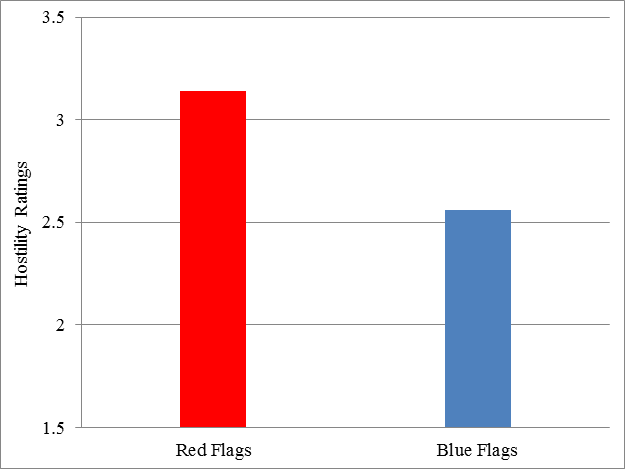 Figure 1. Hostility Ratings for Countries with Red and Blue Flags.Although red-flagged nations are not more hostile, it could still be that red preferences or biases distinguish more and less hostile people within a country. This was the focus of research by Fetterman, Liu and Robinson (in press). Study 1 asked people whether they liked the color blue or red better. Red-preferring individuals scored higher in interpersonal hostility than blue-preferring individuals. Study 2 asked people to identify degraded patches as red or blue and found that people who more hostile were biased to see the color red more often. Study 3 extended Study 2 by comparing biases to see the colors red and green. Study 4 returned to the simple color preference question of Study 1 and found that red-preferring people were more hostile in their social behavior (e.g., by rejecting a monetary offer in order to punish another person). Thus, people who have red-related preferences and biases do appear more hostile and we might be more wary of their potential behaviors for this reason. Indeed, our potential friends or colleagues might be asked how much they like the color red.
article author(s)

Adam Fetterman
Adam received his PhD in Social Psychology from North Dakota State University in 2013. His research focuses on how metaphors reflect and affect our thoughts...more

Michael Robinson
Michael D. Robinson is a Professor of Psychology at North Dakota State University. He received his Ph.D. in social psychology from the...more