
The dish on gossip: Its origins, functions, and bad reputation
Defining Gossip
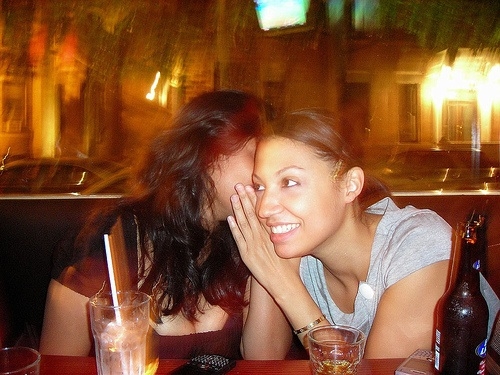 https://www.flickr.com/photos/nycgal/
Gossip’s Bad Reputation
For being such a wide-spread activity, gossip certainly has a poor reputation. There are many potential reasons why gossip is generally regarded with disdain. Many religious doctrines look down on the act of gossip (e.g., “A talebearer reveals secrets, but he who is of a faithful spirit conceals a matter,” Proverbs 11:13; “Do not speak ill of each other behind their backs,” Al-Hujurat 49:12). Being the target of gossip can obviously be an unpleasant experience, especially when the gossip is reputation-damaging or downright false (Paquette & Underwood, 1999). People also have generally negative views of individuals who share negative gossip. In one study, women who spread negative gossip in the workplace were viewed as more power-seeking and less emotionally warm than women who did not spread negative gossip (Farley, Timme, & Hart, 2010). Additional reasons for the condemnation of gossip include the fact that gossip gives power (in the form of knowledge) to lower-status individuals (such as women, see De Sousa, 1994), and that it makes private matters public (Schoeman, 1994; Solove, 2007). The dumbwaiter was purportedly created so that servants could not overhear and share the personal matters of their employers (Hecht, 1956, cited in Foster, 2004, p. 78). Thus, many argue that society’s degradation of gossip stems from the fact that it threatens those in power, who respond in turn by trying to prohibit its occurrence.
Although many view gossip as nothing more than frivolous or hurtful speech that should be eliminated altogether, researchers who study gossip have found much evidence to the contrary. It turns out that gossip actually serves a wide array of useful functions, and that its roots may even be traced back to our primate ancestors.
article author(s)

Ashley Waggoner Denton
Ashley Waggoner Denton received her PhD in Social Psychology from Indiana University in 2012. Her research focuses on impression formation processes,...more